Author: Betsie

  • My Favorite Swedish Comfort Foods

    Swedish food has a special kind of comfort to it—hearty, humble, and full of tradition. Whether it’s a creamy potato dish served at a family gathering or a humble soup that warms you from the inside out, these are the foods that bring me joy and nostalgia. Here are a few of my all-time favorites that always remind me of home, heritage, or just pure coziness.

    Potato Sausage (Potatis Korv)
    This dish is the definition of comfort. A traditional sausage made with ground pork, beef, onions, and—of course—potatoes, it’s rich and flavorful without being too heavy. Served with mustard and boiled potatoes, it’s a must-have during the holidays, but I’d happily eat it year-round.

    Swedish Meatballs (köttbullar)
    There’s a reason these are world-famous. Swedish meatballs are tender, well-seasoned, and served with creamy gravy, lingonberry jam, and mashed potatoes—it’s the perfect balance of savory and sweet. Every family has their own twist, but to me, it always feels like the ultimate comfort food.

    Jansson’s Temptation (Janssons Frestelse)
    This creamy potato casserole is one of my absolute favorites. Thinly sliced potatoes baked with onions, cream, and anchovy-style sprats—it’s rich, savory, and surprisingly addictive. Traditionally served at Christmas, I honestly think it deserves a spot at the table all year long.

    Creamy Dill Potatoes (krämiga dillpotatisar)
    Simple yet so satisfying. These potatoes are often boiled, then tossed in a creamy dill sauce that’s light, tangy, and herby. It’s the kind of side dish that quietly steals the show. Paired with fish or sausage, it just feels like summer on a plate.

    Split Pea Soup with Pancakes (Ärtsoppa och Pannkakor)
    This classic Thursday dish is one of the most nostalgic for me. The yellow split pea soup is hearty and comforting—especially when it’s cold out. But the real treat is the dessert: thin Swedish pancakes served with jam and whipped cream. Sweet, simple, and so satisfying.


    These dishes are more than just meals—they’re memories, traditions, and little pieces of Swedish culture that I carry with me. Whether you’ve grown up with these too or are looking to try something new, I hope this list inspires you to cook up a little Swedish comfort in your own kitchen.

    Here are simple, traditional-style recipes for each of my favorite Swedish dishes:
  • An American Mood

    An American Mood

    Massachusetts 1866

    It is a curious thing, living with a ghost who refuses to be properly dead. Miss Austen rises each morning at precisely the same hour, makes tea as though it were a sacrament, and hums a tune I suspect is designed to annoy me. Our walks into town are an exercise in restraint—for while she nods politely to passersby, I have inherited an American tendency to greet them outright, as though we are all in one large, unwieldy family. Yesterday, she chastised me for greeting a man with ‘Mornin’ to you, sir!’ and told me I was turning into a minister’s wife from New Hampshire.

    We walk in silence until she forgets to be cross, and I forget to be foreign. There is something rather democratic about trudging through mud together.

    Jane burst into laughter, loud and clear. “A minister’s wife from New Hampshire! Charlotte, you must publish this.”

    “Never.”

    “Then I shall plagiarize you.”

    Charlotte smiled, despite herself. “Only if you promise to leave out the part where I said ‘mornin’.”

    Outside, snow fell gently on the silent trees. Inside, two great minds sat warmed by fire and prose, their laughter rising like steam from the teacups between them

    The next morning, Jane and Charlotte bundled themselves in cloaks and boots, setting off on foot to the center of town. The snow had turned slushy in places, making their progress a cautious shuffle. Their errand was simple—order supplies to be delivered to the cottage. Flour, lamp oil, and a fresh tin of tea.

    After placing their order, Jane turned her gaze down the lane. “Shall we visit the bookshop? It’s warmer there than most churches.”

    Charlotte nodded. “So long as no one tries to recommend me a pamphlet on transcendentalism.”

    They walked along the boardwalk and into the bookshop, the little bell above the door ringing.

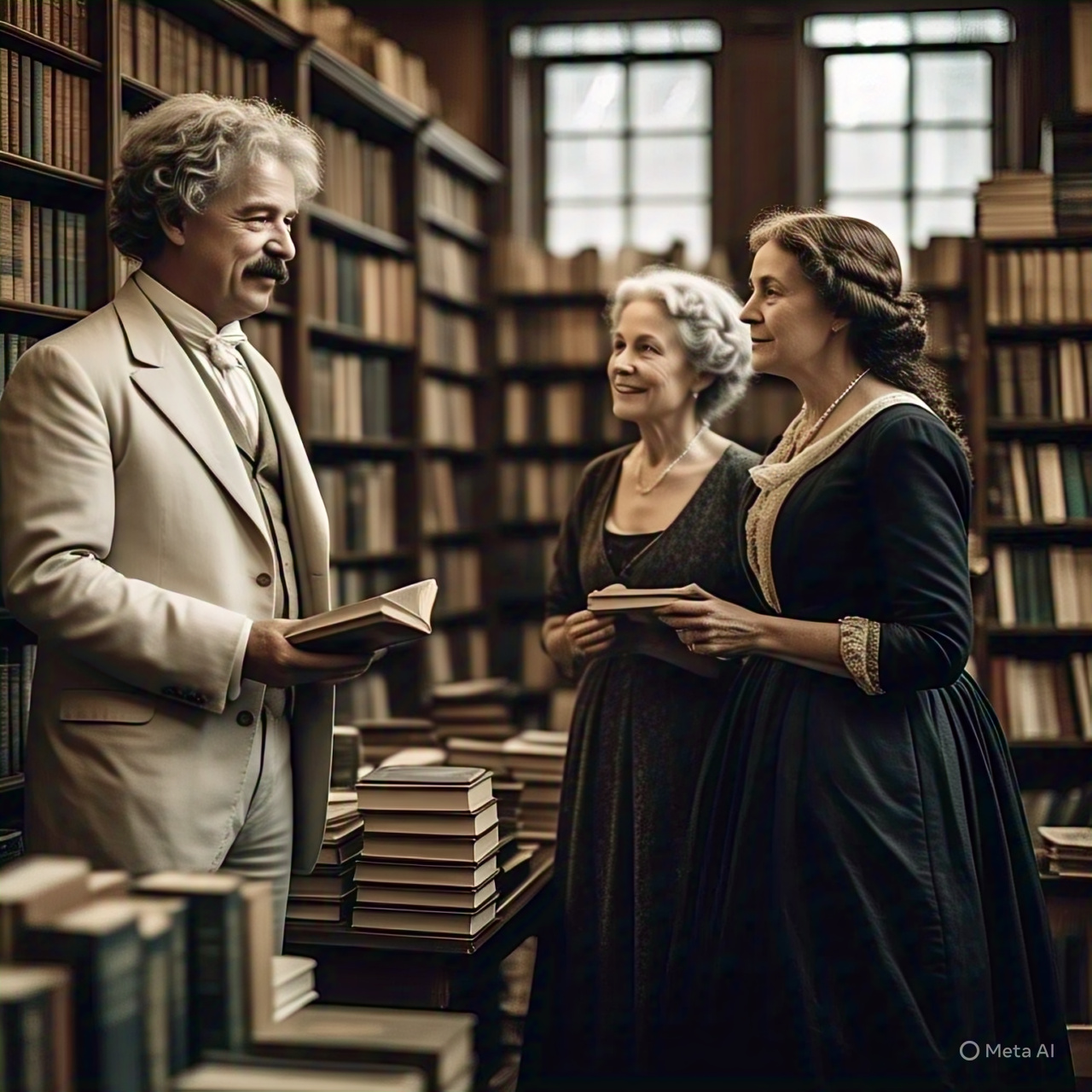
    And there, in the far corner, flipping through a stack of almanacs, stood Samuel Clemens. He looked up as the door creaked.

    Recognition flickered across his face. “Well, if it isn’t the English widow of the Moors—and her ghostly roommate.”

    Charlotte flushed. Jane burst into delighted laughter. The shopkeeper, bewildered, simply adjusted his spectacles.

    “Mr. Clemens,” Jane said, with a half-curtsey. “We feared your wit had fled to warmer climates.”

    “It tried,” he replied, closing the almanac, “but was thwarted by poor train schedules and a cursed fondness for New England bookstores.”

    Charlotte folded her arms. “You’re following us.”

    “Only in the literary sense,” Clemens said with a grin. “Though I might ask—have either of you considered a co-authored memoir? Seems to me the world could use the tale of a Yorkshire exile and a Regency ghost trudging through the democratic mud.”

    Jane raised a brow. “Only if you agree to write the introduction.”

    “On one condition,” he said. “That I’m allowed to compare your parlor to a tugboat and your tea to cannon smoke.”

    Charlotte rolled her eyes. Jane just laughed again.

    In the bookshop’s golden afternoon light, the three of them stood among the shelves—writers from different worlds, arguing, teasing, and, somehow, becoming something perilously close to friends.

  • MEET VERONICA MATEO

    MEET VERONICA MATEO

    THE QUEEN OF CORDLESS GLUE GUNS, EMOTIONAL DAMAGE CONTROL, AND LAST-MINUTE MAGIC

    If there’s a crisis unfolding behind the curtain at your cousin’s wedding or a power outage threatening to derail a museum gala, chances are Veronica Mateo is already there—heels on, headset in, clipboard armed and eyes narrowed at a poorly secured centerpiece.

    At 32, Veronica is half of the dynamic twin duo behind V&V Creative, the city’s trendiest (and most terrifyingly efficient) boutique event agency. With her sister Vivienne handling client schmoozing and high-gloss branding, Veronica is the one backstage making miracles happen—and making them happen on time, under budget, and with just the right number of floating candles.

    “She’s like if Pinterest had a military division,” says one former bride, still misty-eyed when recalling how Veronica rescued her bouquet from a rogue raccoon.

    Veronica also moonlights as the best roommate ever—or worst, depending on your tolerance for 5 a.m. coffee brewing and spontaneous living room centerpiece trials. She shares her apartment with best friend Mimi Mahoney, a bond forged back in high school over shared snacks and boy drama and only deepened through heartbreak, career pivots, and one truly unhinged bachelorette party in Palm Springs.

    While she’s got a no-nonsense streak that could make Gordon Ramsay sweat, those close to her know Veronica’s tough exterior hides a soft heart, a wicked sense of humor, and the ability to rig fairy lights like a Broadway stagehand with a glitter addiction.

    She believes in timelines, tactical spreadsheets, and trusting your gut. She doesn’t believe in fate—but she does believe that if you hot glue rhinestones to your own shoes before a gala, you’re a hero and should be treated as such.

    And honestly? We agree.

  • Notes from the Hearth

    Notes from the Hearth

    Massachusetts, 1866

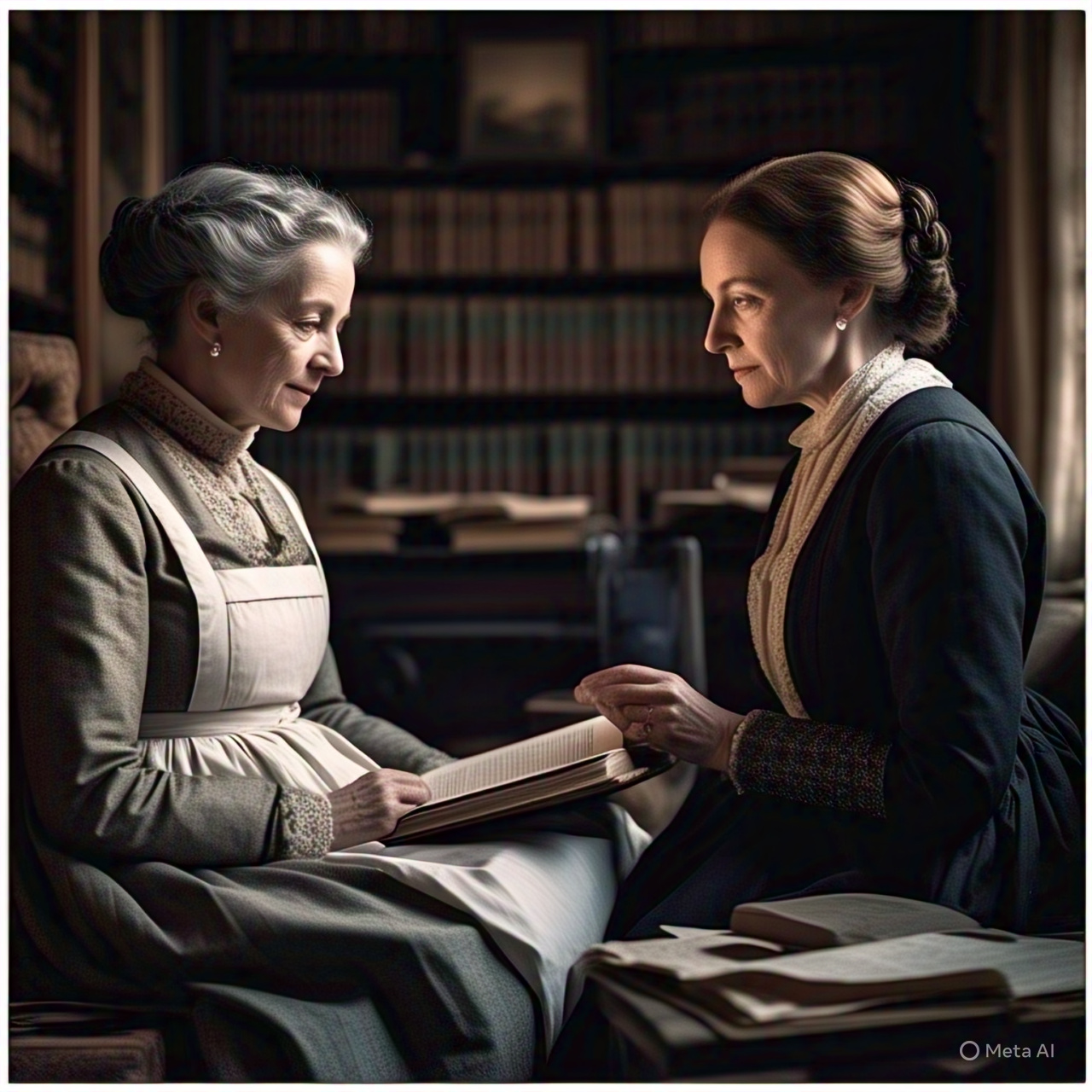
    A late winter sun spilled across the parlor rug, casting long golden streaks onto the worn armchairs and tea table. In one sat Jane Austen, spectacles low on her nose, a faint crease between her brows as she flipped through the final pages of The Innocents Abroad. Opposite her, Charlotte Brontë reclined, arms folded, already frowning.

    “He calls a cathedral a barn,” Charlotte said, breaking the silence. “Then he compares it to a ship, then a goat. I can hardly keep up.”

    “He enjoys chaos,” Jane replied, her voice mild but edged with amusement. “There is precision in it, but it dances so quickly one forgets where it began.”

    Charlotte sniffed. “It lacks discipline. Structure. He’s charming, yes, but the narrative is slippery.”

    “Deliberately so. He guides the reader by wit rather than by compass. I suspect he considers digression a virtue.”

    “Then I pity his editor.”

    Jane smirked, setting the book aside and pouring more tea. “Still, you laughed. Twice. I heard you.”

    “Once. And only because he described an Italian tour guide as a ‘damp sponge soaked in romance.’”

    “A poetic insult. One might say it rivals some of yours.”

    Charlotte softened, reluctantly. “His language is crude at times. Undeniably American.”

    “Yes,” Jane said thoughtfully. “But alive. As if the sentences were spoken before they were written.”

    “I don’t write to mimic speech.”

    “Nor I. But he does, and it suits him.”

    Charlotte tapped a finger on the cover. “Do you think it will last?”

    Jane shrugged. “He captures a particular moment in time. A mood. Whether the world will need it again is uncertain. But it knows itself, which is more than most books can say.”

    They sipped tea in quiet.

    “He’d hate us, wouldn’t he?” Charlotte said finally.

    “He already does,” Jane said dryly. “Or did, before today.”

    Charlotte chuckled. “I almost admire that.”

    “Almost?”

    “I don’t admire men easily.”

    “We have that in common.”

    A longer silence followed. The fire hissed softly.

    Jane glanced toward Charlotte’s writing desk. “You were scribbling there the other morning. What was it?”

    Charlotte shifted uncomfortably. “Nothing for public eyes. Just something about… this. Us.”

    Jane’s brow lifted. “Our cohabitation?”

    “If you must name it.”

    “And why hide it?”

    Charlotte looked into her teacup. “Because the writing sounds American. I find myself using contractions. I described the kettle as ‘clattering like a runaway wagon.’ That’s not Brontë. That’s… Clemens.”

    Jane laughed, a warm ripple. “So the contagion spreads.”

    “It unnerves me.”

    “Perhaps. Or perhaps it means your voice is learning a new accent, not losing its own.”

    Charlotte grunted. “I’d still rather burn it.”

    Jane sipped again, eyes twinkling. “Save it instead. Someday a girl with ink on her hands may find her way into your sentences, and thank you for them.”

    Outside, snow fell gently on the silent trees. Inside, two great minds sat warmed by fire and prose, disagreeing peacefully beneath the low, flickering light.

  • Tea With a Ghost

    Tea With a Ghost

    Massachusetts, 1865

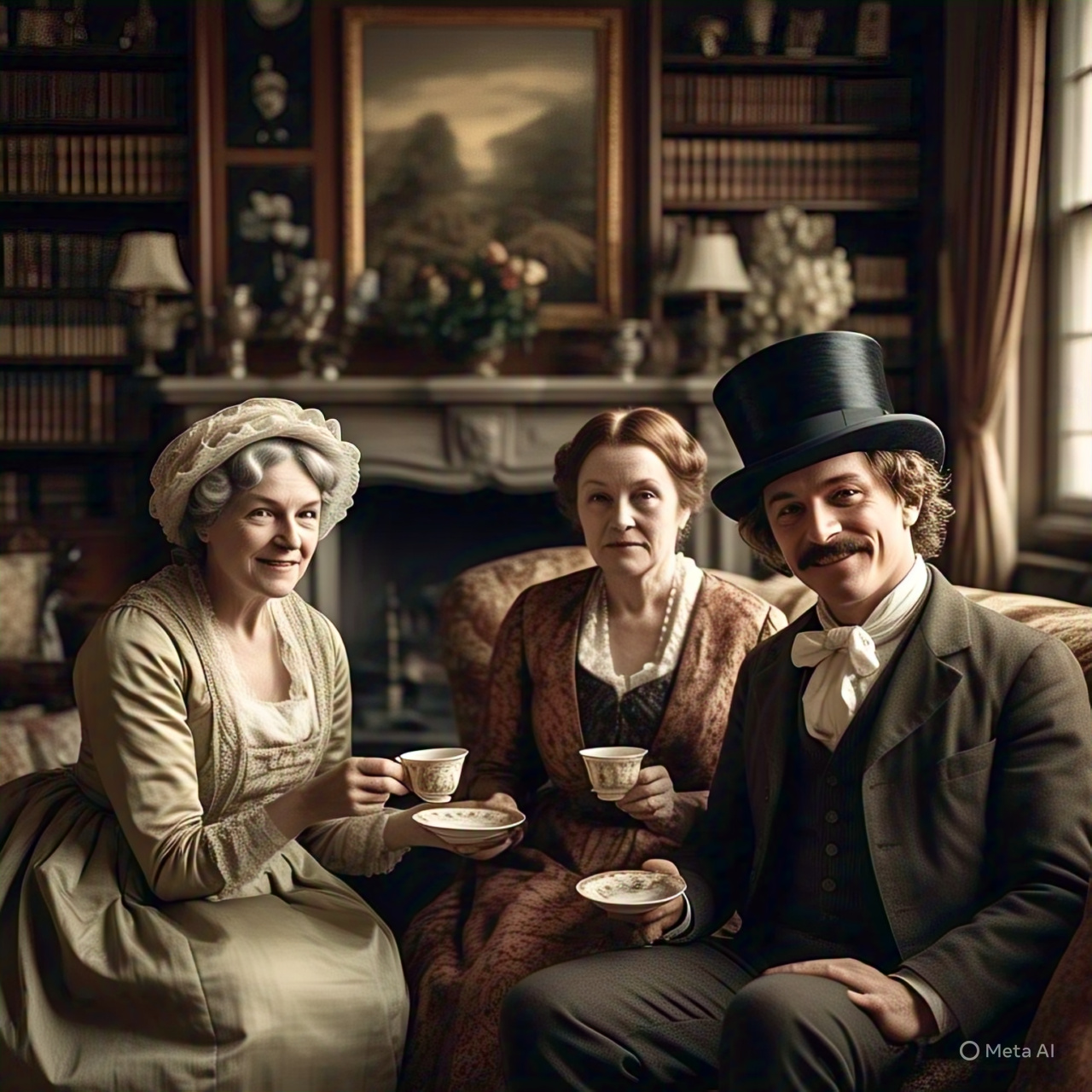
    The leaves flamed red and gold outside a modest cottage tucked behind a veil of quiet maples. The house bore an English air—delicate lace curtains, ivy snaking up its whitewashed exterior, and a brass knocker polished too often for a home with so few guests. Inside, Jane Austen, aged and sharp-eyed at eighty-nine, sat in her writing chair with a shawl wrapped around her thin shoulders. Her days of publication were long past, but her mind remained unclouded, her wit polished by silence and age.

    A knock sounded at the door. She did not hurry. One did not, at her age. She opened it to find a tall man with unruly hair, sun-creased skin, and a smirk that had seen its share of saloons and sermons.

    “Afternoon, ma’am,” he said, doffing his hat. “Samuel Clemens. I’m calling on the bookish folk around here. Thought you might like a look at something I’ve written.” He held out a bundle of papers.

    “And what would that be, Mr. Clemens?” “A travelogue, of sorts. Humorous. Called The Innocents Abroad.”

    “Humor?” she said, arching an eyebrow. “We could use more of that lately. Come in.”

    He stepped inside, eyeing the room with curiosity. Books lined the walls. A fire crackled in a hearth trimmed with carved wood. “Nice place,” he said. “You live alone?”

    “Alone enough.” She settled him into a chair and took the manuscript. Leafing through, she smiled faintly. “You mock with precision, Mr. Clemens. It’s a rare quality.”

    “Well,” he said, adjusting in his seat, “someone’s got to poke holes in all this pomp and piety.”

    “Indeed,” she replied. “Though it takes tact.”

    “You sound like you know a thing or two about it.” 

    “I suppose I do. Jane Austen.”

    He blinked. “Come again?”

    “Pride and Prejudice. Sense and Sensibility. Emma. I imagine you’ve at least insulted one of them.”

    Clemens sat up. “You can’t be. Jane Austen died almost fifty years ago.”

    She poured tea, calm as a librarian in a thunderstorm. “The reports of my death are greatly exaggerated.”

    He stared. Then laughed. “I’ll be damned. I said once I wanted to dig you up and beat you with your own shinbone over Mansfield Park.”

    “And now you have the opportunity,” she said, passing him a cup.

    He took it, bemused. “You’re not what I expected.”

    “Nor are you. But your voice is clear. It carries. With refinement, you could stir more than laughter. You might even change something.”

    “You think so?”

    “I know so.” They sipped tea beneath the hush of autumn wind. The fire danced. Outside, the world changed. Inside, two ghosts of literature—one presumed dead, the other not yet born to fame—shared stories, wit, and the strange comfort of being understood.

    Before leaving, Clemens asked her to sign his copy of Emma. “Proof I drank tea with a ghost,” he said.

    She smiled. “And I with a man who will haunt libraries long after he’s gone.”

    He stepped out into the evening, the manuscript under his arm and a bemused grin still playing on his lips.

    The door had scarcely closed behind him when it opened again, this time without a knock.

    Charlotte Brontë stepped inside, cheeks pink from the crisp air, a basket of vegetables on her arm. She unwound her scarf with practiced ease and gave Jane a sideways glance.

    “You had company.”

    “A curious traveler,” Jane replied, returning to the teapot. “With a sharp tongue and a sharper mind.”

    Charlotte set the basket down. “Did he insult your prose or mine?”

    “Mine, for once. But I think he was more surprised to find me alive.”

    Charlotte snorted. “We’re hardly alive. We’re inconveniently persistent.”

    Jane offered her a fresh cup of tea.

    “He left with your usual skepticism and one of my signed novels.”

    Charlotte accepted the cup. “Another fool convinced the past is buried.”

    They sat in silence for a moment, the fire crackling.

    “You’ve lived with me five years now, Charlotte. Still convinced it was a mistake?”

    “Undoubtedly,” Charlotte said, sipping. “But I’ve made worse ones.”

    Jane smiled. “As have I. But they never stayed long enough to argue over the tea.”

    Outside, the wind stirred the trees. Inside, two authors who never quite liked one another continued the strange truce of their cohabitation, bound by ink, exile, and a house too quiet to endure alone.