Category: short story

  • A Misjudged Moor

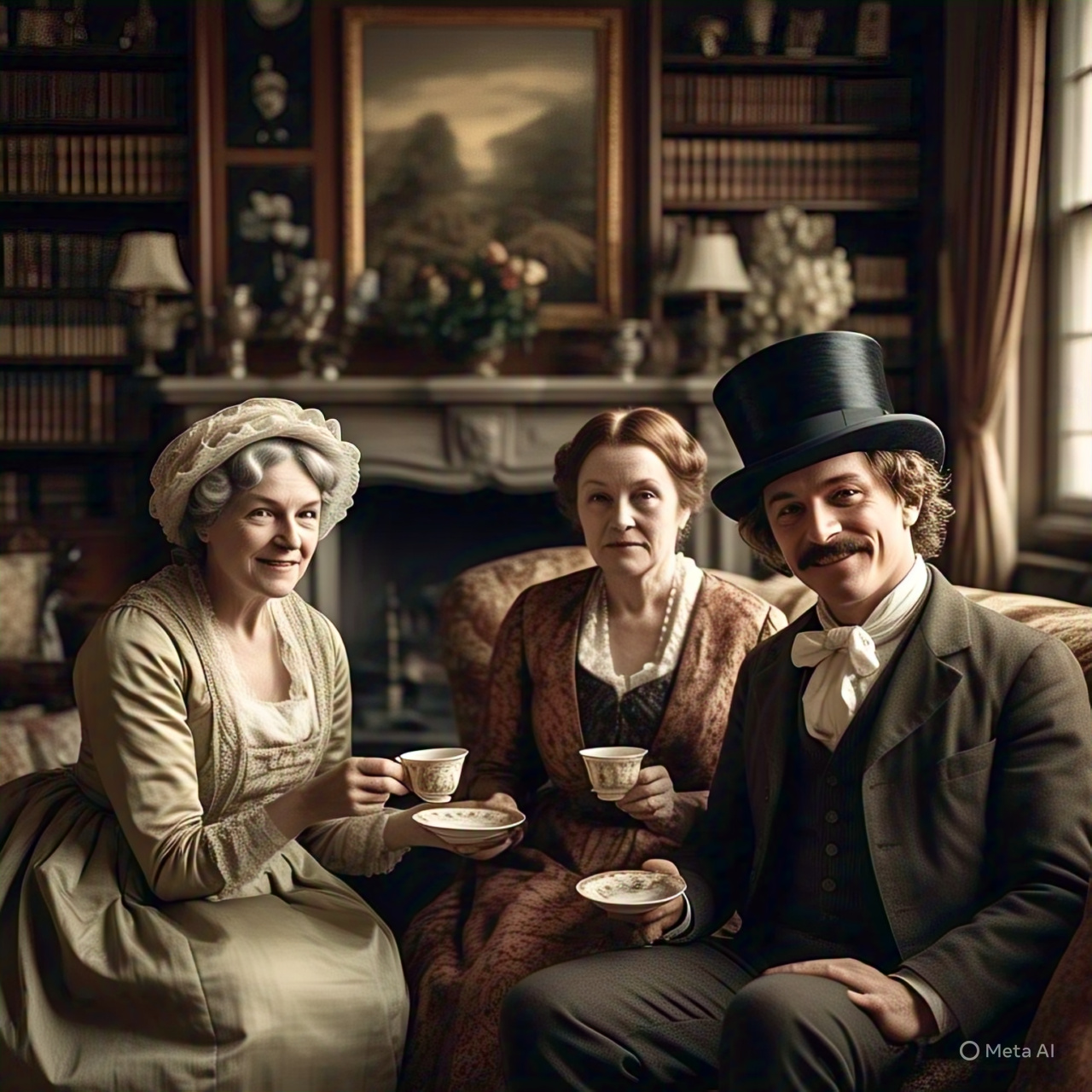
    The wind picked up sometime after their second cup of tea, rattling the shutters in fits, as if it too wished to join the conversation. Jane had taken to mending a glove by the hearth, while Charlotte and Wilkie lingered near the bookshelf, the air between them steadily thickening with literary opinion.

    “You know,” Wilkie said, sipping loudly, “I’ve been meaning to say, while I have the ear of thee Charlotte Brontë, there’s a matter I’ve long pondered.”

    Charlotte, cautious, tilted her head. “Oh?”

    Wuthering Heights,” he began, with a sniff as though even the title gave him indigestion. “Now, there’s a book that could have done with… supervision.”

    Charlotte blinked once. “Pardon me?”

    “Brilliantly atmospheric, yes—I’ll grant that. And a certain rugged appeal. But I daresay the structure is erratic, the characters mad beyond sympathy, and the narrative practically eats its own tail.”

    Jane, sewing, gave a tiny cough that sounded suspiciously like a stifled laugh.

    Wilkie continued, oblivious. “Heathcliff is all brooding snarl and no justification, Catherine is emotionally feral, and don’t get me started on the endless generational recursion by the time I sorted out who was haunting whom, I needed a map and a séance.”

    Charlotte said nothing, her face a perfect mask of still civility. She stared into her teacup like it might prevent violence.

    “Don’t misunderstand me,” Wilkie went on, plucking a biscuit with cheerful ignorance, “There’s promise in it. Real promise. But what it needed. What it cried out for was a steady editorial hand. Yours, perhaps! You, Miss Brontë, you know restraint. You wouldn’t let a ghost story run feral across the page like a moor pony with a fever.”

    Jane dropped her glove in her lap.

    Charlotte finally set down her cup and turned to face him.

    “Mr. Collins,” she said, her voice remarkably even, “do you make a habit of giving unsolicited criticism to authors in their own homes?”

    Wilkie hesitated, then smiled, as if she’d paid him a compliment. “Only when I feel I might be saving a future classic from its worst impulses.”

    “I see,” Charlotte said.

    “And surely you agree with me?” he said, genuinely eager. “It’s too much, that book. All that passion! Like a thunderstorm married a fever dream.”

    Charlotte nodded slowly. “Yes, Mr. Collins. And had I written it, I daresay I’d be wounded.”

    Wilkie blinked. “Had you? I thought…”

    “You thought incorrectly,” Charlotte said, standing now. Her small stature had never seemed quite so formidable. “My sister Emily wrote Wuthering Heights. She died of tuberculosis. Shortly after it was published.”

    Wilkie’s mouth opened. And closed. Then opened again.

    “I… good heavens… I didn’t…”

    Jane, now calmly threading her needle again, said, “You may want to check who you’re insulting next time, Mr. Collins. Especially when ghosts are involved.”

    Charlotte folded her hands. “I must say, Mr. Collins, I admire your courage. It takes a certain fortitude to criticize the dead to her living kin—under their roof—while eating their biscuits.”

    Wilkie looked down at his half-eaten biscuit as though it had betrayed him.

    “I shall… offer my regrets. And my compliments to the biscuit-maker.”

    “That,” Jane said, without looking up, “was also Emily.”

    Wilkie’s eyes widened in horror.

    Charlotte relented, only slightly. “You’re safe, sir. I bake. Emily haunts.”

    “Good lord,” Wilkie muttered, finishing his biscuit anyway.

    Outside, the wind howled a little louder, and a shutter creaked ominously. Wilkie, looking distinctly paler, glanced at the darkened hallway behind them.

    “Forgive me,” he said. “I seem to have developed a sudden and completely irrational fear of narrow staircases.”

    Jane smiled. “We all do, in time.”

    The wind had barely stopped rattling when the door burst open with the force of a cannon shot.

    “Ladies!” cried Samuel Clemens, wild-eyed and snow-dusted, as he staggered into the parlor like a man chased by revelation, or a bear.

    Wilkie Collins let out a startled yelp and nearly dropped his teacup.

    Jane stood up sharply. “Mr. Clemens! What on earth?”

    “No time!” Twain barked, slamming the door behind him with a thud that shook the panes. He was panting, one glove missing, scarf askew, hair in mutinous rebellion.

    Charlotte frowned. “Are you pursued?”

    Twain blinked once, then pointed a trembling finger toward the hearth.

    “It’s happening,” he said, voice low and hoarse. “It’s started. I… I don’t even know how to begin…”

    “What’s started?” Jane demanded.

    Twain opened his mouth, closed it, and looked around at them all as if measuring their fortitude.

    And then he said:

    “You may want to sit down.”
  • Of Apparitions and Plot Twists

    Of Apparitions and Plot Twists

    Massachusetts 1866

    If you are holding this curious volume in your hands, congratulations: you’ve stumbled upon something equal parts improbable and delightful. A sort of literary ghost story, minus the ectoplasm and plus a good deal more sarcasm.

    Now, I’ll be the first to admit I never expected to be the man writing a foreword to a joint chronicle by Miss Jane Austen and Miss Charlotte Brontë—two women who, by rights, ought to have remained politely silent in the annals of history, given the dates printed next to their deaths. But history, like art, has a habit of misbehaving. And so, somehow, they are not only alive but living together in a snow-covered Massachusetts town, where the tea is strong, the grammar stronger, and the opinions stronger still.

    Reading their pages, one quickly learns that Miss Austen’s wit can still slice the bark off a birch tree at ten paces, and Miss Brontë’s scowl can make a man forget his Christian name. What’s more, they are grappling with a strange and wonderful affliction: America. Or, more precisely, American-ness—the informal talk, the muddy roads, the unsettling cheerfulness of strangers, and the creeping infection of slang into the prose of very proper Englishwomen.

    It is a rare thing to witness two minds of such caliber batting the world about like a shuttlecock. Rarer still when one of those minds begins to wonder aloud whether she’s begun to sound like me. I can assure you, gentle reader, that is both a compliment and a confession.

    So here it is: the laughter, the quarrels, the long walks into town. A chronicle of cohabitation written in the margins of time. And if I’ve come off looking a bit foolish in the process—well, I had it coming.

    Sincerely, Samuel Langhorne Clemens
    Hartford, Connecticut, 1867

    Back at the cottage, Jane and Charlotte read over Samuel’s introduction again, now bound at the front of the first galley proofs of their memoir. Charlotte made several scoffing noises, and Jane laughed until she had to set her tea down.

    “He is either brilliant or completely irredeemable,” Charlotte declared.

    “And you don’t think the two can coexist?”

    Before Charlotte could answer, a knock rattled the front door.

    Jane stood, smoothing her skirt. “I’m not expecting anyone.”

    Charlotte followed her to the door, both curious and mildly alarmed.

    When Jane opened it, a sharp-eyed man in a cravat and traveling cloak stood on their porch, half-snowed and entirely windblown.

    “Ladies,” he said, with a courteous nod. “Forgive the intrusion, but I believe I’ve found exactly the ghosts I’m looking for.”

    “Pardon?” Charlotte blinked.

    “Wilkie Collins,” he said. “Author, traveler, enthusiast of the inexplicable. I read about English ghosts living in a Massachusetts village and thought: either this is a hoax or my next novel.”

    Jane stepped aside, bemused. “Do come in, Mr. Collins.”

    As he entered and shed his coat, he looked about the room like a detective at a crime scene. “Marvelous. You do look spectral in this lighting. Might I impose upon you for guidance? I’m planning a new mystery—working title, The Moonstone—and I confess I need a touch more… gothic.”

    Charlotte narrowed her eyes. “You wrote The Woman in White.”

    “Guilty.”

    “It kept me awake.”

    “Then I’m flattered.”

    Jane gestured to the hearth. “Sit. Warm yourself. And tell us—what exactly did you hear about us in London?”

    Collins grinned. “Only that Miss Austen had returned from the dead, and Miss Brontë had followed her across the Atlantic. I had to see if it was true.”

    Charlotte muttered, “You could have written.”

    “Where’s the suspense in that?”

    They sat by the fire, a new kettle set to boil. Another voice, another pen, another improbable chapter in the strange, shared tale of authors who simply refused to stay buried.

    As the fire crackled and Wilkie removed his gloves with a flourish, Jane rose from her chair.

    “I’ll see to the tea,” she said, brushing her hands down the front of her apron. “Charlotte, do keep Mr. Collins company. Try not to haunt him.”

    With that, she vanished into the kitchen, leaving the parlor in flickering warmth and curiosity.

    Wilkie leaned forward with theatrical intensity. “Miss Brontë, I must tell you about The Moonstone. It concerns a cursed diamond, stolen from an Indian shrine and brought—foolishly—into an English country estate.”

    Charlotte nodded slowly. “Stolen artifacts, colonial guilt, family secrets. A solid beginning.”

    “Indeed,” Wilkie beamed. “There’s an opium addict. A puritan housemaid with a spiritual superiority complex. And a butler who loves Robinson Crusoe so dearly he consults it as a moral compass.”

    Charlotte’s eyes widened, then narrowed. “That borders on parody.”

    “Parody dances awfully close to truth, doesn’t it?”

    She tilted her head. “Does the moonstone do anything? Glow? Whisper? Possess house pets?”

    “No,” he said, almost proudly. “It just… is. Heavy with history. Still. Cold. A weight no one quite knows how to carry.”

    Charlotte sat back, considering. “Then give it atmosphere. The house must creak. The portraits must leer. And for heaven’s sake, give someone a dream they can’t quite shake, one that smells faintly of sandalwood and guilt.”

    Wilkie’s eyes lit up. “Yes, yes—exactly that. You see, Miss Brontë, I knew you’d understand.”

    “And the diamond,” she added, tapping her teacup with one finger. “Don’t let it sit idle. Let it judge.”

    Wilkie stared. “Let it… judge?”

    “Like a ghost in mineral form.”

    From the kitchen, Jane called, “That’s precisely the sort of sentence I’m going to carve into the biscuit tin.”

    Charlotte turned toward the door. “We’re discussing literature, not refreshments!”

    “And I,” Jane replied cheerily, “am saving you from putting a vengeful gemstone in someone’s porridge.”

    Wilkie laughed heartily. “I must say, your domestic arrangement is far more haunted than I expected. I feel I’ve walked into a séance run by two schoolmistresses.”

    Charlotte raised a brow. “We’re better than a séance. We finish the stories afterward.”

    He nodded, solemn. “That’s the best kind of haunting.”

    The kettle shrieked in the next room. Jane returned moments later with a tray of steaming cups, which she passed around like an officiant at some sacred rite.

    And as the wind whispered around the corners of the little Massachusetts cottage, three literary souls sat sipping tea, plotting mysteries, and warming their hands by a fire that never quite went out.

  • An American Mood

    An American Mood

    Massachusetts 1866

    It is a curious thing, living with a ghost who refuses to be properly dead. Miss Austen rises each morning at precisely the same hour, makes tea as though it were a sacrament, and hums a tune I suspect is designed to annoy me. Our walks into town are an exercise in restraint—for while she nods politely to passersby, I have inherited an American tendency to greet them outright, as though we are all in one large, unwieldy family. Yesterday, she chastised me for greeting a man with ‘Mornin’ to you, sir!’ and told me I was turning into a minister’s wife from New Hampshire.

    We walk in silence until she forgets to be cross, and I forget to be foreign. There is something rather democratic about trudging through mud together.

    Jane burst into laughter, loud and clear. “A minister’s wife from New Hampshire! Charlotte, you must publish this.”

    “Never.”

    “Then I shall plagiarize you.”

    Charlotte smiled, despite herself. “Only if you promise to leave out the part where I said ‘mornin’.”

    Outside, snow fell gently on the silent trees. Inside, two great minds sat warmed by fire and prose, their laughter rising like steam from the teacups between them

    The next morning, Jane and Charlotte bundled themselves in cloaks and boots, setting off on foot to the center of town. The snow had turned slushy in places, making their progress a cautious shuffle. Their errand was simple—order supplies to be delivered to the cottage. Flour, lamp oil, and a fresh tin of tea.

    After placing their order, Jane turned her gaze down the lane. “Shall we visit the bookshop? It’s warmer there than most churches.”

    Charlotte nodded. “So long as no one tries to recommend me a pamphlet on transcendentalism.”

    They walked along the boardwalk and into the bookshop, the little bell above the door ringing.

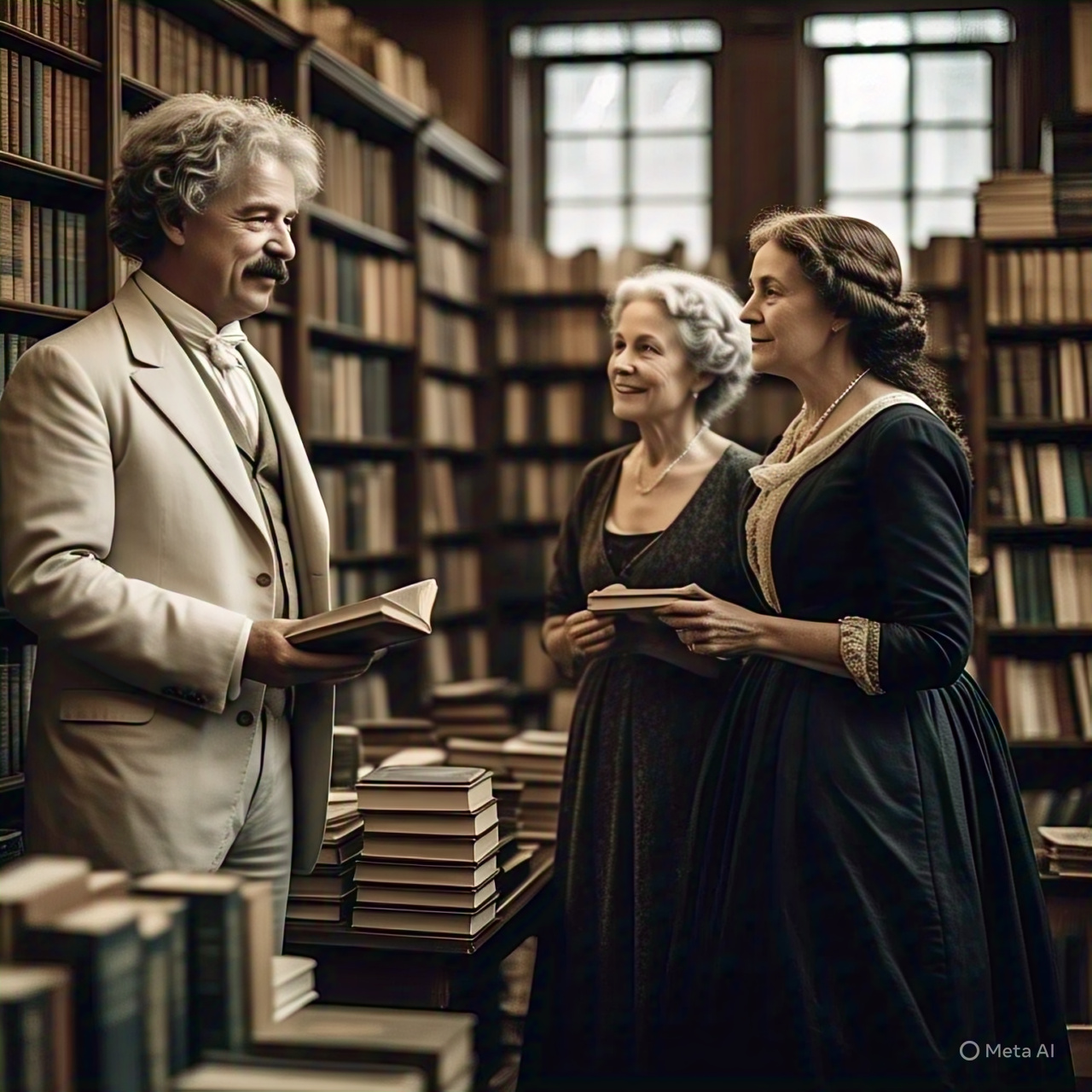
    And there, in the far corner, flipping through a stack of almanacs, stood Samuel Clemens. He looked up as the door creaked.

    Recognition flickered across his face. “Well, if it isn’t the English widow of the Moors—and her ghostly roommate.”

    Charlotte flushed. Jane burst into delighted laughter. The shopkeeper, bewildered, simply adjusted his spectacles.

    “Mr. Clemens,” Jane said, with a half-curtsey. “We feared your wit had fled to warmer climates.”

    “It tried,” he replied, closing the almanac, “but was thwarted by poor train schedules and a cursed fondness for New England bookstores.”

    Charlotte folded her arms. “You’re following us.”

    “Only in the literary sense,” Clemens said with a grin. “Though I might ask—have either of you considered a co-authored memoir? Seems to me the world could use the tale of a Yorkshire exile and a Regency ghost trudging through the democratic mud.”

    Jane raised a brow. “Only if you agree to write the introduction.”

    “On one condition,” he said. “That I’m allowed to compare your parlor to a tugboat and your tea to cannon smoke.”

    Charlotte rolled her eyes. Jane just laughed again.

    In the bookshop’s golden afternoon light, the three of them stood among the shelves—writers from different worlds, arguing, teasing, and, somehow, becoming something perilously close to friends.

  • Notes from the Hearth

    Notes from the Hearth

    Massachusetts, 1866

    A late winter sun spilled across the parlor rug, casting long golden streaks onto the worn armchairs and tea table. In one sat Jane Austen, spectacles low on her nose, a faint crease between her brows as she flipped through the final pages of The Innocents Abroad. Opposite her, Charlotte Brontë reclined, arms folded, already frowning.

    “He calls a cathedral a barn,” Charlotte said, breaking the silence. “Then he compares it to a ship, then a goat. I can hardly keep up.”

    “He enjoys chaos,” Jane replied, her voice mild but edged with amusement. “There is precision in it, but it dances so quickly one forgets where it began.”

    Charlotte sniffed. “It lacks discipline. Structure. He’s charming, yes, but the narrative is slippery.”

    “Deliberately so. He guides the reader by wit rather than by compass. I suspect he considers digression a virtue.”

    “Then I pity his editor.”

    Jane smirked, setting the book aside and pouring more tea. “Still, you laughed. Twice. I heard you.”

    “Once. And only because he described an Italian tour guide as a ‘damp sponge soaked in romance.’”

    “A poetic insult. One might say it rivals some of yours.”

    Charlotte softened, reluctantly. “His language is crude at times. Undeniably American.”

    “Yes,” Jane said thoughtfully. “But alive. As if the sentences were spoken before they were written.”

    “I don’t write to mimic speech.”

    “Nor I. But he does, and it suits him.”

    Charlotte tapped a finger on the cover. “Do you think it will last?”

    Jane shrugged. “He captures a particular moment in time. A mood. Whether the world will need it again is uncertain. But it knows itself, which is more than most books can say.”

    They sipped tea in quiet.

    “He’d hate us, wouldn’t he?” Charlotte said finally.

    “He already does,” Jane said dryly. “Or did, before today.”

    Charlotte chuckled. “I almost admire that.”

    “Almost?”

    “I don’t admire men easily.”

    “We have that in common.”

    A longer silence followed. The fire hissed softly.

    Jane glanced toward Charlotte’s writing desk. “You were scribbling there the other morning. What was it?”

    Charlotte shifted uncomfortably. “Nothing for public eyes. Just something about… this. Us.”

    Jane’s brow lifted. “Our cohabitation?”

    “If you must name it.”

    “And why hide it?”

    Charlotte looked into her teacup. “Because the writing sounds American. I find myself using contractions. I described the kettle as ‘clattering like a runaway wagon.’ That’s not Brontë. That’s… Clemens.”

    Jane laughed, a warm ripple. “So the contagion spreads.”

    “It unnerves me.”

    “Perhaps. Or perhaps it means your voice is learning a new accent, not losing its own.”

    Charlotte grunted. “I’d still rather burn it.”

    Jane sipped again, eyes twinkling. “Save it instead. Someday a girl with ink on her hands may find her way into your sentences, and thank you for them.”

    Outside, snow fell gently on the silent trees. Inside, two great minds sat warmed by fire and prose, disagreeing peacefully beneath the low, flickering light.

  • Tea With a Ghost

    Tea With a Ghost

    Massachusetts, 1865

    The leaves flamed red and gold outside a modest cottage tucked behind a veil of quiet maples. The house bore an English air—delicate lace curtains, ivy snaking up its whitewashed exterior, and a brass knocker polished too often for a home with so few guests. Inside, Jane Austen, aged and sharp-eyed at eighty-nine, sat in her writing chair with a shawl wrapped around her thin shoulders. Her days of publication were long past, but her mind remained unclouded, her wit polished by silence and age.

    A knock sounded at the door. She did not hurry. One did not, at her age. She opened it to find a tall man with unruly hair, sun-creased skin, and a smirk that had seen its share of saloons and sermons.

    “Afternoon, ma’am,” he said, doffing his hat. “Samuel Clemens. I’m calling on the bookish folk around here. Thought you might like a look at something I’ve written.” He held out a bundle of papers.

    “And what would that be, Mr. Clemens?” “A travelogue, of sorts. Humorous. Called The Innocents Abroad.”

    “Humor?” she said, arching an eyebrow. “We could use more of that lately. Come in.”

    He stepped inside, eyeing the room with curiosity. Books lined the walls. A fire crackled in a hearth trimmed with carved wood. “Nice place,” he said. “You live alone?”

    “Alone enough.” She settled him into a chair and took the manuscript. Leafing through, she smiled faintly. “You mock with precision, Mr. Clemens. It’s a rare quality.”

    “Well,” he said, adjusting in his seat, “someone’s got to poke holes in all this pomp and piety.”

    “Indeed,” she replied. “Though it takes tact.”

    “You sound like you know a thing or two about it.” 

    “I suppose I do. Jane Austen.”

    He blinked. “Come again?”

    “Pride and Prejudice. Sense and Sensibility. Emma. I imagine you’ve at least insulted one of them.”

    Clemens sat up. “You can’t be. Jane Austen died almost fifty years ago.”

    She poured tea, calm as a librarian in a thunderstorm. “The reports of my death are greatly exaggerated.”

    He stared. Then laughed. “I’ll be damned. I said once I wanted to dig you up and beat you with your own shinbone over Mansfield Park.”

    “And now you have the opportunity,” she said, passing him a cup.

    He took it, bemused. “You’re not what I expected.”

    “Nor are you. But your voice is clear. It carries. With refinement, you could stir more than laughter. You might even change something.”

    “You think so?”

    “I know so.” They sipped tea beneath the hush of autumn wind. The fire danced. Outside, the world changed. Inside, two ghosts of literature—one presumed dead, the other not yet born to fame—shared stories, wit, and the strange comfort of being understood.

    Before leaving, Clemens asked her to sign his copy of Emma. “Proof I drank tea with a ghost,” he said.

    She smiled. “And I with a man who will haunt libraries long after he’s gone.”

    He stepped out into the evening, the manuscript under his arm and a bemused grin still playing on his lips.

    The door had scarcely closed behind him when it opened again, this time without a knock.

    Charlotte Brontë stepped inside, cheeks pink from the crisp air, a basket of vegetables on her arm. She unwound her scarf with practiced ease and gave Jane a sideways glance.

    “You had company.”

    “A curious traveler,” Jane replied, returning to the teapot. “With a sharp tongue and a sharper mind.”

    Charlotte set the basket down. “Did he insult your prose or mine?”

    “Mine, for once. But I think he was more surprised to find me alive.”

    Charlotte snorted. “We’re hardly alive. We’re inconveniently persistent.”

    Jane offered her a fresh cup of tea.

    “He left with your usual skepticism and one of my signed novels.”

    Charlotte accepted the cup. “Another fool convinced the past is buried.”

    They sat in silence for a moment, the fire crackling.

    “You’ve lived with me five years now, Charlotte. Still convinced it was a mistake?”

    “Undoubtedly,” Charlotte said, sipping. “But I’ve made worse ones.”

    Jane smiled. “As have I. But they never stayed long enough to argue over the tea.”

    Outside, the wind stirred the trees. Inside, two authors who never quite liked one another continued the strange truce of their cohabitation, bound by ink, exile, and a house too quiet to endure alone.